
Tools and Best Practices to Support Regulatory Innovation

To support the expansion of the electricity system, many regulators are being asked to enable new technologies, business models, and market participants while upholding their core mandate to protect customers and ensure reliable, affordable service.
Yet many regulatory frameworks were designed for energy systems that look quite different, and as the pace of expansion accelerates, regulators are finding new ways to innovate and keep their frameworks responsive to the evolving needs of consumers and the system.
Dunsky was recently retained by econext, a non-profit focused on accelerating clean growth in Newfoundland and Labrador, to explore these new approaches. We conducted research into the innovation best practices being adopted by regulators across North America and identified ways in which jurisdictions are systematizing procedural improvements to enable innovation.
These approaches can fall into four general categories or ‘tools.’ Below, we outline these tools, as well as several key themes stood out among regulatory leaders.
Innovation Tools
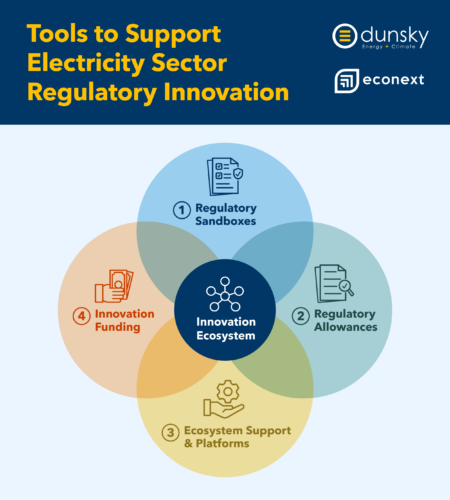
1. Regulatory sandboxes
Regulatory sandboxes create structured environments where utilities and market actors can test new technologies or services under limited regulatory flexibility. A defining feature is early, informal engagement between proponents and regulators, allowing ideas to be explored before entering formal proceedings.
Example: Ontario’s Energy Board Innovation Sandbox enables utilities and third-party vendors to discuss project concepts with OEB staff and, where appropriate, seek temporary relief from specific regulatory requirements. This approach reduces uncertainty, accelerates learning, and helps both regulators and proponents better understand how innovations interact with existing rules.
2. Regulatory allowances
Rather than creating new programs, some regulators are adapting existing approval processes to better accommodate innovation. These adjustments recognize that pilot projects may deliver value through learning, increased data, and future optionality—and would be ineligible under the established regulatory process.
Example: In Nova Scotia, the NS Utility and Review Board (now the Nova Scotia Energy Board) introduced Innovation Justification Criteria within its capital approval framework, allowing innovative projects to proceed based on their ability to test new approaches, generate insights, or support future business cases. The aim is to create a clearer regulatory pathway for experimentation and its benefits while maintaining review rigour.
3. Ecosystem support and collaboration platforms
Innovation benefits from collaboration across utilities, regulators, researchers, and solution providers. Dedicated platforms and test beds facilitate knowledge-sharing, joint problem-solving, and capacity-building across the electricity ecosystem.
Example: In New York, the state’s Grid CONNECT initiative brings stakeholders together through an “Idea Exchange” and phased engagement process to identify system challenges, support testing, and share outcomes. By aligning innovation efforts with regulatory and system priorities, the platform aims to strengthen both market readiness and regulatory understanding.
4. Innovation funds
Targeted innovation funds help reduce financial risk and broaden participation in early-stage projects, particularly when paired with clear system objectives and regulatory oversight.
Example: California’s Electric Program Investment Charge (EPIC) program provides ratepayer-funded support for research, development, and demonstration projects that advance grid reliability, clean energy integration, and resilience. By funding innovation across multiple stages of maturity, EPIC seeks to help translate promising concepts into solutions regulators and utilities can evaluate and scale.
Key Themes
In addition to these four tools, we saw several key themes emerge that are shaping regulatory innovation:
- To facilitate meaningful change, an innovation ecosystem is required, which often contains elements of all four tools. For example, in Ontario, innovation funding is offered through the IESO Grid Innovation Fund while the OEB Sandbox offers regulatory relief and ecosystem support.
- Tools often overlap. Regulatory sandboxes can include elements all four tools. For example, in Connecticut, their Innovation Energy Solutions sandbox includes funding and ecosystem support/collaboration tools.
- Informal communication pathways between regulators and stakeholders are an important preamble for innovation. Reducing the procedural barriers to communication can support faster implementation of innovation and accelerate learning about the energy regulatory system, strengthening trust amongst stakeholders in the energy ecosystem.
- Program or process design is important to meet innovation goals. Many programs reviewed focus on specific project types or technology readiness levels. Establishing clear performance metrics is essential to support ongoing program evolution and ensure regulatory/utility goals are met.
For regulators and utilities navigating the energy transition, thoughtful regulatory innovation is increasingly essential to ensuring frameworks evolve alongside the systems they oversee. If you wish to learn about our research and how we can support regulatory innovation, contact us at info@dunsky.com.
Related Insights
- Read more about Emerging Best Practices for Resource Procurement
Emerging Best Practices for Resource Procurement
August 21, 2025
With electricity demand surging and infrastructure aging, utilities face pressure to procure new generation quickly, cost-effectively and reliably. Around the…

- Read more about New Report: Canada’s Renewable Energy Market Outlook: Wind. Solar. Storage
New Report: Canada’s Renewable Energy Market Outlook: Wind. Solar. Storage
August 1, 2025
Robust market intelligence to support decision-makers The Market Opportunity for Wind, Solar and Storage Today, Canada ranks 9th globally for installed…
- Read more about Webinar Summary – Energy Corridors: Expanding Interprovincial Electricity Transmission and Trade
Webinar Summary – Energy Corridors: Expanding Interprovincial Electricity Transmission and Trade
May 21, 2025
Original Air Date: Monday, June 16, 2025 In our recent webinar, Philippe Dunsky was joined by Mark Sidebottom (Chief Clean…