

Decarbonization Pathways for Equipment in Canada’s Construction and Agriculture Sectors

Key Takeaways
- The availability of zero-emission agricultural and construction equipment is increasing globally
- Electric vehicles represent the most promising pathway for decarbonization in these sectors thanks to superior energy efficiency, lower operating costs and growing market momentum
- While many types of equipment and applications can be electrified today, others have energy demands and duty cycles that are out of reach of current battery technology. The extent to which these segments will rely on alternatives like low-carbon fuels or hydrogen in the long term will depend on the pace of battery technology improvements.
- Barriers to EV charging exist for select applications, some of which may be unlocked via mobile charging or battery swapping
- Policymakers and utilities can optimize the benefits of electric and low-carbon equipment through incentive programs and managing or leveraging large loads through smart charging and vehicle-to-grid initiatives
The Future is (Increasingly) Now
Low-carbon technology advancements in the off-road transportation sector are accelerating. Once thought unachievable, numerous options now exist to decarbonize industrial vehicles and equipment. Dunsky recently completed an assessment of such options available for the agriculture and construction sectors. The research revealed a clear trend: the availability of zero-emission—and, particularly, electrified—solutions that can decarbonize industrial equipment is rapidly increasing.
Rapid Technological Advances
Our research indicates that for both the agriculture and construction sectors that electrification is already within reach of a range of duty cycles within common equipment segments, including compact loaders, utility tractors, backhoes and other low- to mid-horsepower machinery. We also found that manufacturers globally are signalling their intentions to introduce new models and have introduced prototypes or production plans that target more off-road segments.
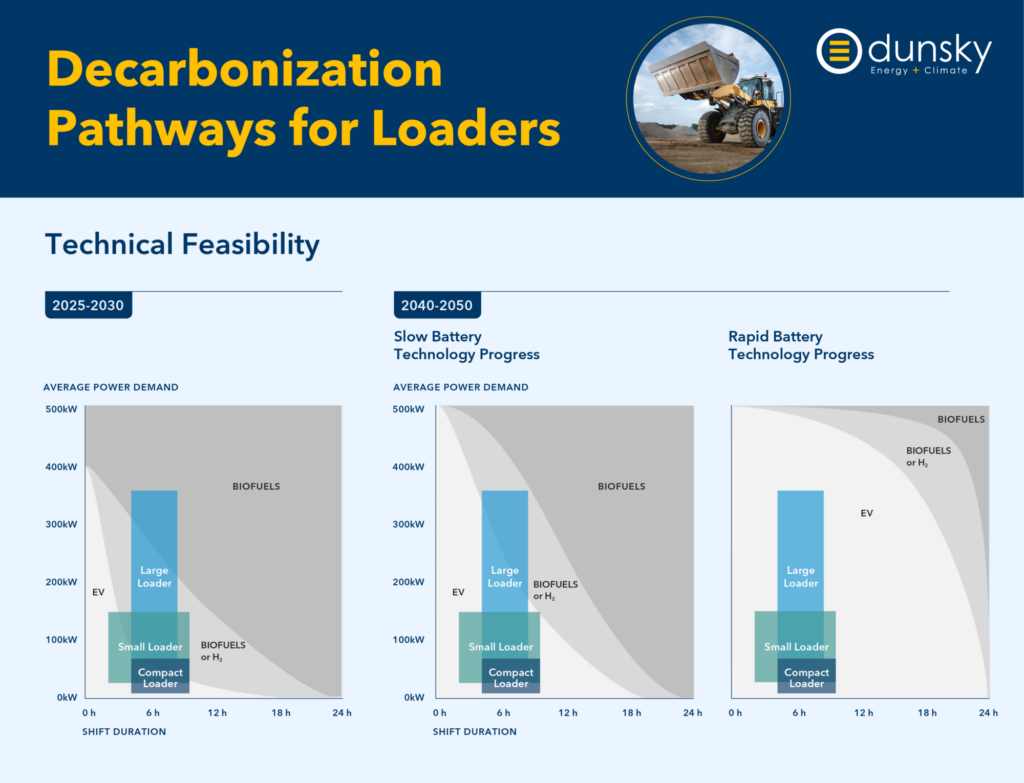
Not all equipment is suitable for electrification in the near term, however. High-horsepower, long-duration operations—such as continuous digging in dense soil or multi-day fieldwork—still press against the limits of today’s battery technology. In these cases, low-carbon fuels and, in specific circumstances, hydrogen could fill the gaps. As battery density improves and costs decline, however, electrification is expected to expand into many of these more demanding applications. Our modelling indicates that several equipment segments and utilization profiles considered out of reach today will become technically feasible within the coming decades, thanks to improvements in battery energy density.
Implications for Utilities and Policymakers
This shift means that utilities and policymakers should no longer ask whether electrification will happen in these industrial sectors but focus on how best to prepare for it.
Infrastructure is a central consideration. Construction sites, particularly mobile or remote ones, often lack reliable access to power. Despite this, international examples demonstrate that progress is possible. The City of Oslo, for instance, required municipal construction sites to be zero-emission in 2025. Non-municipal construction sites will need to meet the standard by 2030. Early grid connections and mobile charging units have been key to unlocking early opportunities. These models can help guide Canadian jurisdictions as they explore similar requirements.
For utilities, growing electrification in off-road sectors will introduce meaningful new electricity demand while also enabling significant emission reductions and improved local air quality. Understanding where and when this load will emerge is essential for effective planning. Opportunities also exist to integrate smart charging and, eventually, vehicle-to-grid services, particularly in agricultural settings in cases where equipment returns to a central location on a regular basis.
For governments, the findings can provide a measure of confidence that the transition in industrial segments is both possible and, in many cases, economically favourable thanks to reduced operating and maintenance costs. Incentive programs can help accelerate adoption where barriers remain, whether for equipment purchases, infrastructure, or low-carbon fuels.
Leading Research and Solutions in Electric and Low-Carbon Mobility
The results of our research are further proof that credible decarbonization solutions exist across sectors of the economy once thought to be extremely difficult to decarbonize. Since 2017, Dunsky’s Mobility team has helped utilities, governments, regulators and corporations understand the pace and magnitude of the transition to decarbonized transportation and how they can play a meaningful role. We invite you to contact our team at info@dunsky.com to learn more.
Related Insights
- Read more about Charging in Sync: Coordinating EV Infrastructure in Multifamily Housing for Equitable Electrification
Charging in Sync: Coordinating EV Infrastructure in Multifamily Housing for Equitable Electrification
July 15, 2025
As EV adoption grows, uncoordinated charging in multifamily housing risks higher costs, grid strain, and inequitable access. This article makes…
- Read more about From System Planning to Smart Chargers: Take-aways from our “Next 20” Webinar Series
From System Planning to Smart Chargers: Take-aways from our “Next 20” Webinar Series
June 5, 2025
Dunsky recently concluded its 20th anniversary webinar series “The Next 20” which explored the key technology, policy and market developments…
- Read more about Electric fleets can’t wait: reforms to help grid match pace of change
Electric fleets can’t wait: reforms to help grid match pace of change
April 24, 2025
Canada’s electricity sector requires reform if it is to meet growing demand from transportation electrification, particularly from medium- and heavy-duty…